
Developing friendships and social skills in school are as important as learning academics but often overlooked. Social goals and building friendships are often mentioned in school conferences but are seldom fully explored. Many times, a student’s support team thinks academic success is the key to future accomplishments, but friendships go beyond school into employment and life. Finding a friend is an important component of an individual’s social life.
Social development includes interacting with others, participating in activities, and learning through those interactions. As humans, we are all social beings and need interaction to continually learn and grow. Schools often include social goals in the Individualized Education Program (IEP) annual goals, setting specific targets for social improvement. For example:
Main Goal: Miquel will improve his social skills.
- Objective 1: Miquel will ask one person to play a game with him.
- Objective 2: Miquel will sit with a peer to play a game for 20 minutes.
- Objective 3: Miquel will have a reciprocal conversation with two exchanges during the game.
There are many opportunities for social interactions at school that are sometimes missed due to limited time constraints and the need to keep activities moving. With some planning and creative thinking, however, these moments can become valuable chances to develop friendships and enhance social exchanges. From elementary to high school, there are many chances to build social networks. At the secondary grade levels, students have even more options as the variety of classes offered expands. At each level, an adult facilitator may be needed to guide the relationship or to offer ongoing support.
Consider the following options as places where an autistic student and his/her peers can begin to develop meaningful relationships given the opportunity:
- Before school: Students can participate with others in places like the gym, cafeteria or hall instead of going straight to class.
- In the halls: A peer buddy can walk with the autistic student to the next class or to the library, gym or cafeteria. Sometimes the student might need to leave early to avoid hallway congestion which could cause sensory challenges.
- Before class starts: Peers can assist students in prepping for class or simply chat until class begins, just like other students do.
- Class breaks: Going to get a drink or having some down time in class can be supported by peers.
- Group activities in class: Autistic students should be placed in a group that has peers who know them and understand their strengths and interests.
- Lunch: Include the autistic students with everyone else and use peer support instead of having them sitting alone or at the special education table.
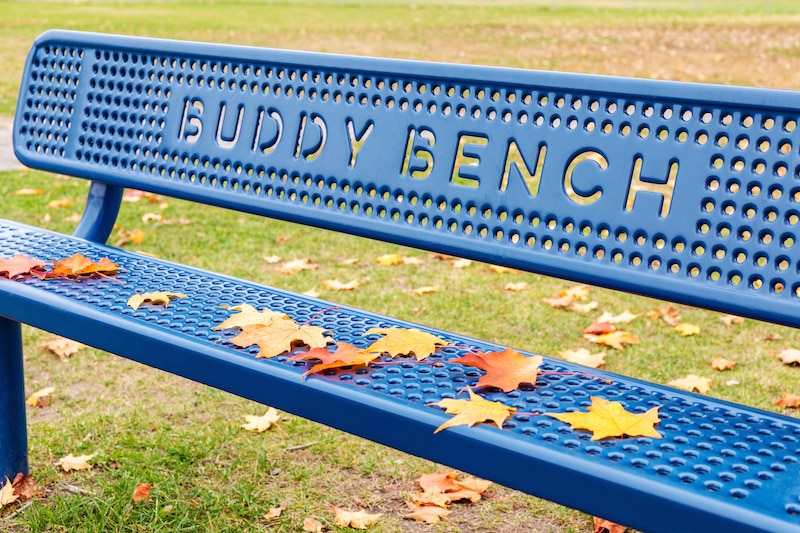
- Recess: Consider having a “buddy bench” where students can go to sit if they can’t find anyone to play with during recess. Peer buddies can be trained to watch for anyone who sits down at the bench and then offer to play with them. This is the perfect time to have peers interact and support the autistic student. They can rotate by doing a different activity of interest with the student or introducing a new activity.
- After-school activities: Elementary activities may be after school day care or extended day programs. These certainly offer opportunities for autistic students to play with their peers. Other events tend to be held in the evening for the family. Middle and high school offers a variety of activities that are immediately after school such as clubs, music, or sports events.
- Music: Many schools have a music program that can offer autistic students chances to participate. Perhaps they do not sing every number but instead ring a bell, tap a drum, or hold a prop and be involved throughout the performance.
- In middle and high school, there are more musical options that become available. Learning to play an instrument and joining the band can lead to other opportunities such as a concert band, marching band, jazz band or pep band for sporting events. There are also drumline groups in some schools. Orchestras would play concerts and musical plays.
- One does not need to play an instrument to enjoy music. Middle and high schools also have choirs and choral groups that sing at school events as well as compete.
- Finally, if a student really enjoys music there is always the need for band boosters who provide support for the various music activities at schools.
- Drama: A theatre program may potentially be available at middle school but certainly at the high school level. There are different parts of putting on a play that a student may enjoy besides being an actor with a role. The other aspects include creating the set, managing the sound, adjusting the lighting, setting up and moving set props, cuing the actors, and designing and creating the costumes. Each aspect involves a different skillset and may tap the interests of the student with autism.
- Clubs/Organizations: Schools have an abundance of extra-curricular organizations that could be fun for any autistic individual based on his/her interests. The huge interest in certain books or movies often creates a place to begin exploring ideas. Here is a sample listing: Art Club, Best Buddies, Chess Club, Digital Arts Society, Environmental Club, Habitat for Humanity Group, newspaper, Robotics Club, Campus Life, Diversity Club, yearbook, Helping Hands, Peer Mediation, Diversity Club, Speech and Debate Club, Science Olympiad Team, or Foreign Language Club.
- Sports: Finally, there are athletic events at both the middle and high school levels that offer a wide variety of opportunities for interaction from participating in a team to being a member in some other fashion. Options include, but are not limited to managers, scorekeepers, timekeepers, equipment caretakers, equipment room managers, and batboy/girl.
- With athletics comes cheerleading, or pom squad opportunities as well as marching band which are also a big part of middle and/or high school. Here someone could participate in cheering but also in creating posters or signs for the school, making announcements, posting announcements or posters or creating any other team spirit materials. Some of these options may involve trying out for the sport, which can be more challenging than others when it comes to creating meaningful social interactions but are still worth exploring as even small and successful interactions can eventually grow into true friendships.
Consider the use of peers in each situation to begin the process of relationship building and helping your students build a community based on interests and skills. Their life and the lives of their peers will be greatly enriched.
Citation:
Second edition (2025) written by Melissa Dubie, M.S.
(Original by Kim Davis, 2010 Finding a Friend in School).
0 Comments